
News from space. Comet C/2019 Q4 is coming up
By Giovanni Sapere
2 min read
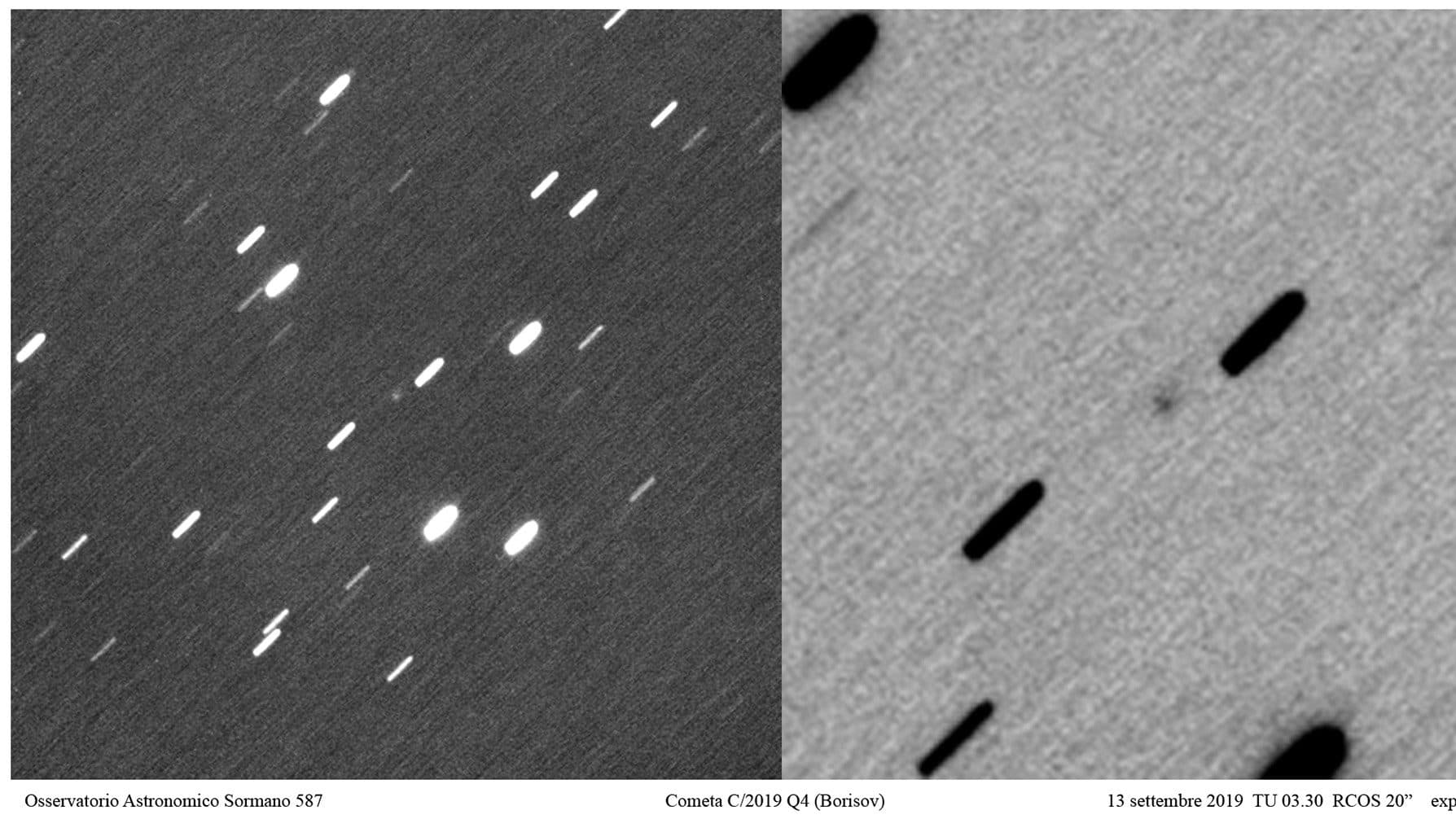
Billions of cosmic objects orbit in space, yet one of them is attracting the attention and curiosity of astronomers around the world. It’s called C/2019 Q4, and it’s a comet. Discovered at the end of August by Gennady Borisov, the space object is making an orbital path different from all other celestial bodies known until now. And here theories follow each other more or less realistic.
Space is rich in cosmic objects of more or less known matter. However, from time to time, some objects of indefinite nature and origins come to “visit” us. This was the case, for example, of the cigar comet Oumuamua, whose origin is presumed to come from a solar system with two Suns. However, a second space object would be heading towards our Solar System.
Read also on The Patent: Hubble Telescope Upends Theory on How the Early Universe Cleared Its Cosmic Fog · “Edscottite” is the new mineral found in nature · ESA announces first mission to remove garbage from the sky · Orbital Matter 3D Prints a 30 Centimeter Boom in Orbit · 29 April: asteroid 52768 expected to pass through the Earth
An Interstellar Comet? C/2019 Q4 Comet Borisov Credit: https://www.youtube.com/watch?v=rnpn0ZgTm7M
The studies
Published on September 12, but revised a few days ago, the first study was published on the Cornwell University website. Detected by the Institute’s data mining system, the spatial object has a colour similar to that of the native comets of the Solar System. Equipped with an orbital eccentricity of 3.16 +/- 0.13, the data assimilate the ‘photometric’ nucleus to ~500 m, however the orbit of the comet describes a parabola. This last aspect is undoubtedly a novelty for the native comets of our Solar System, but if we excluded it, we would be talking about an interstellar comet.
The second study in order of time, published on September 14, is by the Canary Islands Institute of Astrophysics. By studying the spectrum, Spanish scholars have deduced that the composition is similar to comets originated in our solar system. However, the parabolic orbit that C/2019 Q4 is describing, shows how it is heading towards the Sun at a speed never seen before. According to forecasts, around the first ten days of December, the interstellar comet will reach the perihelion, and then definitively exit our Solar System. Probably, the comet must have originated in our Solar System, however, it will have escaped the gravitational attraction of our galaxy millions of years ago. The experiments carried out in the laboratory do not completely exclude an extrasolar origin for C/2019 Q4.
Frequently asked questions
Who discovered comet C/2019 Q4?
Gennady Borisov, at the end of August.
What did the first studies find?
A study published on September 12 found a colour similar to native comets of the Solar System and a nucleus of about 500 m. A second study, published on September 14 by the Canary Islands Institute of Astrophysics, found from the spectrum a composition similar to comets from our solar system.
What is unusual about its orbit?
The comet describes a parabolic orbit, which is a novelty for native comets of the Solar System, and it is heading towards the Sun at a speed never seen before.
When will it reach the Sun?
According to forecasts, around the first ten days of December the comet will reach perihelion and then leave the Solar System. Laboratory experiments do not completely exclude an extrasolar origin.