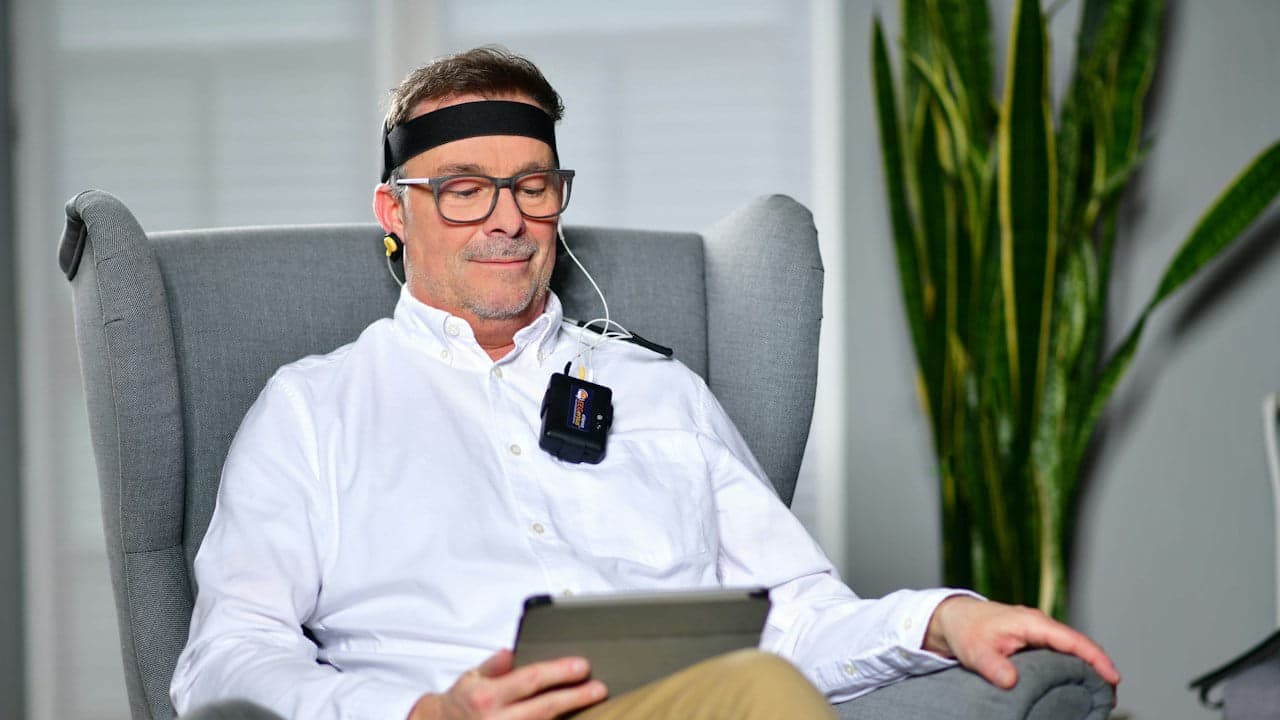
Fraunhofer IDMT Develops Wearable trEEGrid Patch for 24-Hour EEG Monitoring
The flexible sensor records stable brain activity across daily routines and overnight sleep without the discomfort of standard laboratory caps.
By Letizia Giugliano
2 min readHuman-Edited, AI-Assisted

Researchers at the Fraunhofer Institute for Digital Media Technology IDMT have validated a flexible electrode patch capable of recording stable brain activity over a continuous 24-hour period. The study, published in the journal Sensors, demonstrates that the wearable system functions reliably during routine daytime tasks and natural sleep. This invention provides a practical method for long-term neurological monitoring in everyday environments.
Moving brain monitoring out of the laboratory
Standard electroencephalography, known as EEG, typically relies on rigid cap systems and wet gel electrodes that restrict patients to controlled clinical environments. These setups often cause physical discomfort, making multi-hour assessments impractical. To overcome these limitations, the Mobile Neurotechnologies group at the Fraunhofer Institute for Digital Media Technology IDMT in Oldenburg engineered an innovation in wearable sensor configurations designed for continuous home use, as reported by MedicalXpress.
“Our current sensor solution already captures EEG signals in basic everyday situations with high contact stability. It can be worn much more discreetly, is significantly more comfortable and can therefore be used for longer periods than traditional systems”
— Dr.-Ing. Insa Wolf, head of Mobile Neurotechnologies at Fraunhofer IDMT
Engineering the flexible electrode patch
The system centers on trEEGrid, an eight-channel flexible electrode patch that attaches directly to the skin like an adhesive bandage. Supported by a patent, the invention features pre-applied conductive material, allowing reliable surface adhesion without applying mechanical pressure to the skull. To minimize signal distortion caused by cable movement, the patch connects directly behind the ear to a custom miniature amplifier developed by Brain Products GmbH, while a lightweight base unit carried in a pocket supplies power, according to MedicalXpress.
Testing signal stability across day and night
To evaluate recording quality, ten participants wore the medical device continuously for 24 hours, performing cognitive tasks such as Sudoku puzzles, sensory stimulation tests, relaxation exercises, and sleeping in their own homes. The team measured electrical resistance between skin and electrodes, known as impedance, to track connection quality over time. Average impedance remained below 140 kOhm across all eight channels during the first day and dropped below 100 kOhm on the second day, according to MedicalXpress. The recorded signals remained clear enough to differentiate mental workload between easy and difficult puzzle levels.
Future clinical testing and computational analysis
Following initial trials with research staff, the team plans to validate the patch on broader, diverse patient cohorts and during dynamic activities such as walking and cycling. The researchers are also integrating motion sensors and artificial intelligence algorithms to filter out muscular artifacts and eye movements, as noted by MedicalXpress. Led by Dr.-Ing. Insa Wolf, the group aims to apply the mobile platform to investigate sleep conditions, daytime fatigue, epilepsy, and neurodegenerative disorders under real-life conditions.
Read also on The Patent: REMspace: the first oneiric communication – a dream come true? · The t-shirt that produces energy: ‘can power a smartwatch’