Physicists Engineer Fractional Fermi Sea in Ultracold Atoms
Researchers at the University of Innsbruck and CNRS drive cesium atoms out of equilibrium to uncover an ordered quantum state.
By Letizia Giugliano
2 min readHuman-Edited, AI-Assisted
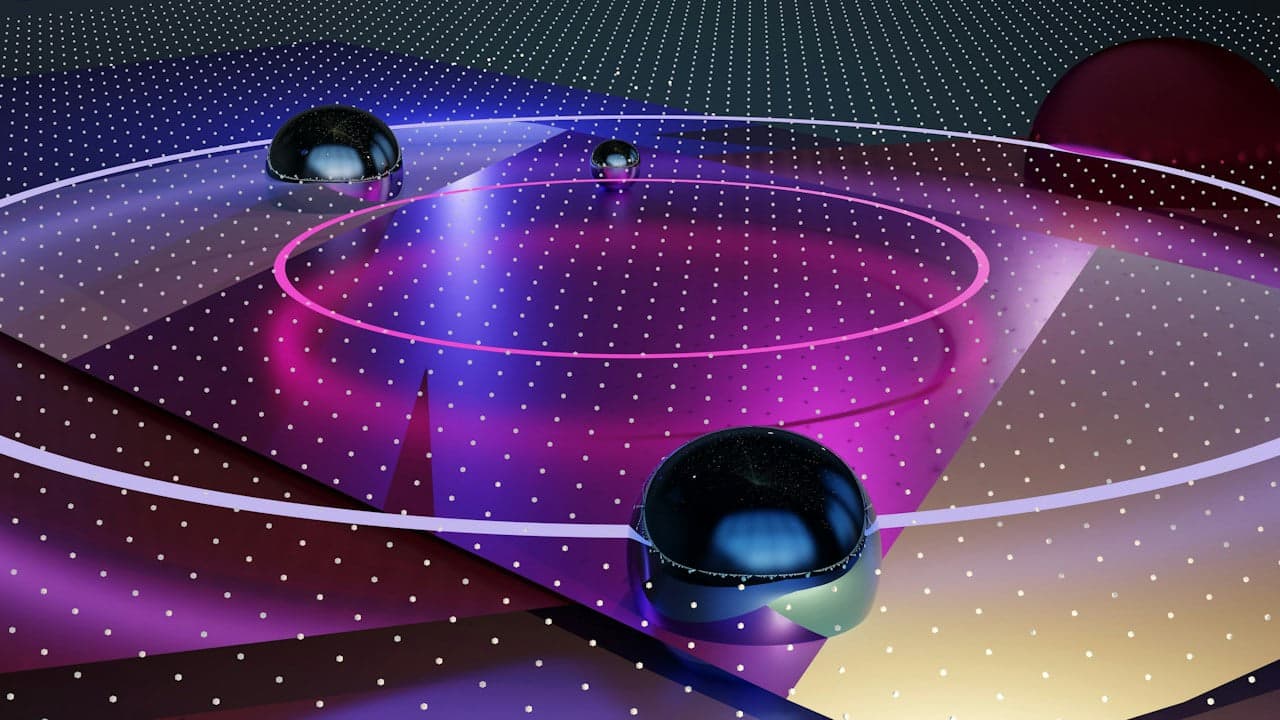
A research team led by the University of Innsbruck, in collaboration with French theorists, has engineered an exotic quantum configuration known as a fractional Fermi sea. Reported in Physical Review Letters, this scientific innovation demonstrates that ultracold atoms subjected to alternating attraction and repulsion maintain a structured order rather than collapsing into thermal disorder.
Driving ultracold atoms beyond equilibrium
Under standard conditions at near absolute zero, quantum particles occupy discrete energy states in predictable configurations, such as the Fermi sea observed in electrons and other fermions. According to a report by ScienceDaily, researchers investigated what happens when those stable conditions are intentionally disrupted, pursuing a critical innovation in the manipulation of quantum states.
To test this, the research team confined ultracold cesium atoms into a one-dimensional system, restricting their movement along a single axis to achieve precise interaction control. Theoretical physicist Alvise Bastianello of the CNRS and Université Paris-Dauphine modeled the effect of continuously cycling the atoms between strong mutual repulsion and strong mutual attraction. As lead author Yi Zeng noted in the study, this cycling drove the atoms from their lowest-energy ground state into an excited configuration without causing chaotic thermal heating, establishing a structured many-body state.
“This state is highly excited, but it is not random. It has a hidden order that becomes visible in its correlations.”
— Hanns-Christoph Nägerl, University of Innsbruck
Mathematical patterns and Friedel oscillations
The resulting arrangement, designated a fractional Fermi sea, departs from typical non-equilibrium behavior by maintaining a distinct internal organization. As detailed by ScienceDaily, the configuration exhibits characteristic wave-like density ripples known as Friedel oscillations, which trace the way quantum particles influence one another.
The researchers also detected anomalous correlation decays between particles across distances, even when repulsive forces remained relatively low. These specific mathematical signatures diverge from predictions based on Tomonaga-Luttinger liquid theory, the established framework used to describe interacting quantum particles in one dimension, showing that the state operates outside traditional equilibrium models.
Emergent quasiparticles and theoretical questions
The discovery provides a theoretical and experimental foundation for work at the University of Innsbruck's Department of Experimental Physics, overseen by group leader Hanns-Christoph Nägerl. The research highlights how coordinated particle behavior produces collective excitations, known in physics as quasiparticles, that act as individual entities within the system.
Because the observed behavior cannot be fully explained by existing one-dimensional models, researchers are evaluating how to classify these collective phenomena. As documented by ScienceDaily, Nägerl noted that the unusual excitations might represent a distinct class of entities, tentatively suggesting the term super-Fermions as research into these non-equilibrium states continues, offering fresh insights that may inspire future invention in advanced quantum technologies.
Read also on The Patent: Cosmic Discovery: J1249+36 Speeds Towards the Unknown · NASA revolutionizes the space experience with augmented reality