Physicists Observe Supersolid State of Light and Matter at Room Temperature
An optical microcavity built by European researchers combines superfluid flow and crystal order without deep-freeze cooling
Physicists at the University of Warsaw, IBM Research Zurich and partner institutions have observed a supersolid state of matter at room temperature. The scientific discovery, published in Science Advances, bypasses the cryogenic equipment previously required to study this dual quantum state.
Merging crystal order and zero viscosity in an optical cavity
Physicists from the Faculty of Physics at the University of Warsaw, the Military University of Technology in Poland, IBM Research Zurich and the French CNRS have produced a supersolid inside an exciton-polariton Bose-Einstein condensate, as reported by Phys.org. Theorists predicted supersolids in the 1960s, and experimentalists first confirmed them using ultracold atoms in 2017. The state combines frictionless superfluid flow with the periodic spatial pattern of a crystal. Instead of cooling atomic clouds near absolute zero, the TopoLight research consortium trapped hybrid quasiparticles of light and matter inside a microcavity, using light-matter coupling to sustain the quantum state under normal ambient conditions—a scientific innovation that bridges fundamental physics and practical devices.
“Our liquid-crystal microcavities can operate even at temperatures approaching 60°C.”
Prof. Wiktor Piecek, Military University of Technology
“This is a textbook example of spontaneous symmetry breaking. Theory predicted that the supersolid could choose among several equivalent states, and that is exactly what we observed.”
Prof. Guillaume Malpuech, Institut Pascal (CNRS)
Liquid crystals and organic semiconductors withstand 60 degrees
The experimental device uses an optical microcavity filled with a liquid crystal and coated with a thin film of the organic semiconductor MeLPPP, short for methyl-substituted ladder-type poly(paraphenylene). According to Professor Wiktor Piecek from the Military University of Technology, whose group engineered the liquid-crystal structures, these assemblies can operate at temperatures approaching 60°C. Exciton-polaritons inside the cavity persist for only a few picoseconds. That brief lifespan gives the hybrid particles enough time to condense and behave as a frictionless quantum superfluid without complex refrigeration units.
Fringes, spin helices and spontaneous symmetry breaking
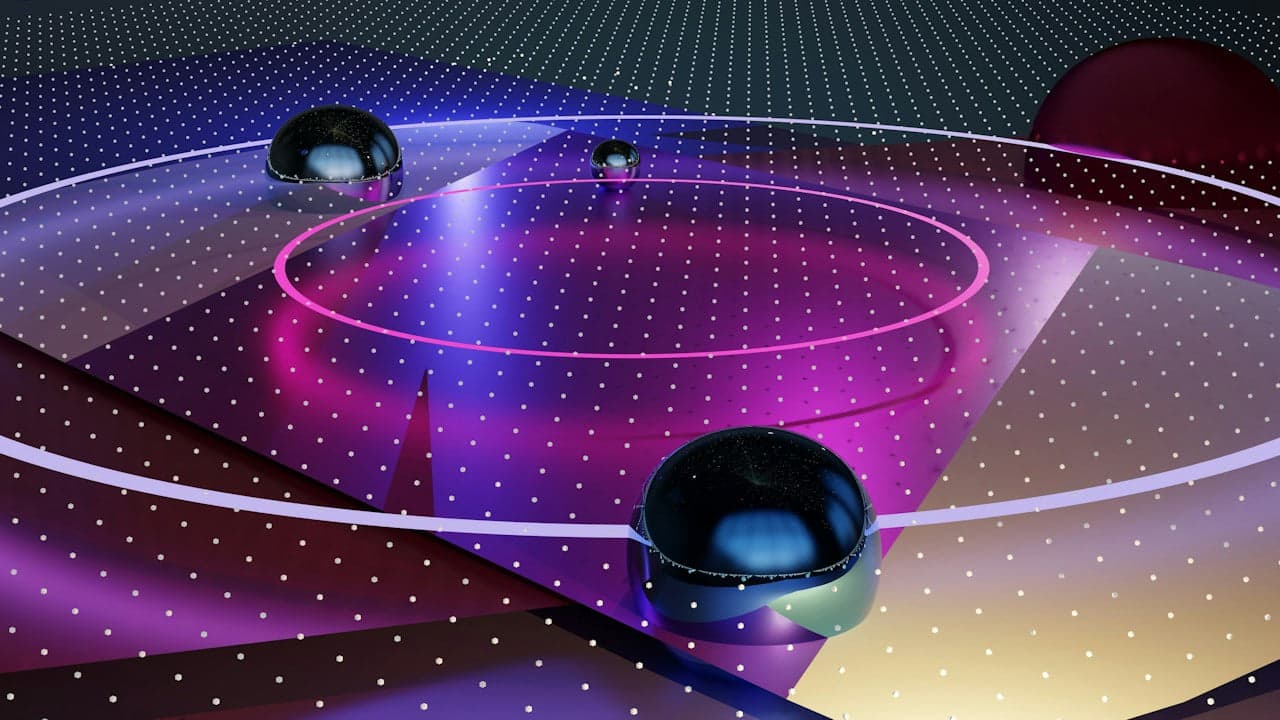
When researchers stimulated the sample with laser pulses, the emitted light organized into regularly spaced bright fringes. These fringes served as optical proof that the condensate formed a periodic density modulation matching a crystalline lattice. The fringes also shifted position with each subsequent pulse. Professor Guillaume Malpuech from Institut Pascal at CNRS noted that the quantum system spontaneously selected one of several equivalent configurations, demonstrating spontaneous symmetry breaking. The condensate created a persistent spin helix at the same time, producing a periodic modulation of light polarization alongside the spatial intensity pattern.
Fabrication limits and prospects for optical hardware
The experimental materials degraded quickly. Dr. Marcin Muszyński, lead author of the study and a postdoctoral researcher at The City College of New York, stated that the organic semiconductor reacted chemically with the liquid crystal over time, giving researchers just a few hours to complete measurements after assembly before needing to build a replacement. Thin films of MeLPPP deposited at IBM Research Zurich allowed the group to record the necessary data before degradation set in. Demonstrating supersolidity without liquid helium refrigeration offers practical ground for technology transfer in ultrafast optical devices, room-temperature photonic circuits and neuromorphic computing architectures designed for artificial intelligence, making this invention a promising foundation for future patent applications.
Read also on The Patent: Ben Krasnow 3D prints a clear Einstein-Szilard refrigerator powered by flame · A microscopic Archimedes screw spins between gold tips and boosts conductivity