Print and Place turns ordinary 3D printers into automated circuit assemblers
Researchers use molten plastic as a temporary gripper to pick and insert electronic components during fused deposition modeling
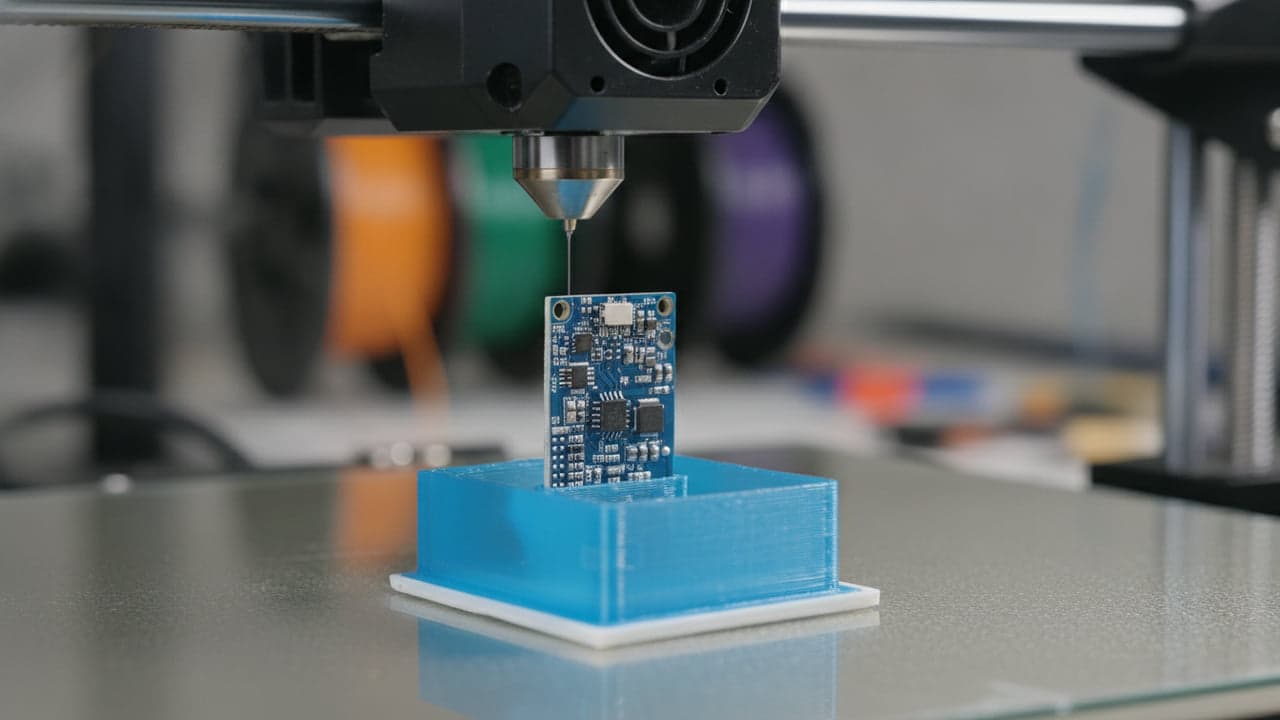
A research team led by Oliver Child has introduced an invention that enables standard fused deposition modeling machines to embed electronic components inside plastic parts without modifying the printer hardware. The method uses standard print heads and extruded thermoplastic to pick up and place circuit elements directly during the build process.
Molten plastic as a temporary pick tool
Building objects with internal circuitry typically requires an operator to pause a fabrication run and insert parts by hand. As reported by Hackaday, the project titled "Print & Place: Using a 3D printer for Continuous Assembly of Electronic Devices" by inventor Oliver Child and colleagues bypasses that manual step through a clever hardware innovation. The team relies on unmodified fused deposition modeling hardware, turning the extrusion nozzle itself into a temporary manipulator. Instead of fitting a dedicated vacuum gripper or mechanical actuator, the machine deposits a small dab of hot thermoplastic onto a component stored on the build plate. The plastic sticks to the component, lifts it from a parametric tray, and transports it to the target position on the printed structure.
Routing wires and printed circuit boards in G-code
The fabrication routine coordinates both part geometry and electronics through standard G-code commands. Before printing begins, an operator populates a custom parametric tray on one section of the print bed with parts. During the automated run, the 3D printing head travels to the tray, secures a component with fresh plastic, moves it into place, and then continues building layers over it to lock it into the structure. In three experimental demonstrations of this invention, Child and the team embedded pre-populated printed circuit boards, flexible strips of conductive wire and braid, and metallic rivets to form vertical connections between conductive layers.
Handling open-loop limits on the build plate
The system currently operates without external sensors or closed-loop positioning. Experiments documented by the researchers showed occasional pick failures, misalignment during placement, and inconsistent electrical contacts. Because standard stepper motors follow pre-programmed coordinates without verifying contact, slight physical shifts can prevent a circuit from closing properly. To address these mechanical limits, integrating techniques from modern robotics, such as an optical camera system similar to commercial pick-and-place industrial units, could provide automated feedback to the machine firmware, allowing real-time positional adjustments or alerting human operators when an error occurs.
Read also on The Patent: A 3D-printed robot moth grows UV sensors using its own artificial blood · Dr. Kun Dániel Builds an AI-Guided Lockpicking Robot