Cornell chip cools trapped ions to quantum ground state in 150 microseconds
Integrated photonics accelerate laser cooling by three times and clear a key hurdle for scaling trapped-ion hardware

Engineers at Cornell University have built a chip-based laser-cooling device that cools a trapped ion close to its quantum ground state in 150 microseconds. The hardware invention cuts the cooling time to roughly one third of what standard laser setups require, addressing a central operating bottleneck in quantum computing.
Routing light on chip to suppress thermal noise
Trapped-ion systems rely on charged atoms held by electromagnetic fields to hold and process information. Before these ions can execute logic gates, researchers must strip away unwanted motional energy using targeted laser light. In traditional arrangements, this preparation consumes a large portion of machine runtime. Marking a notable technological innovation, an engineering team led by Karan Mehta, an assistant professor of electrical and computer engineering at Cornell’s Duffield College of Engineering, replaced free-space optics with integrated waveguides etched directly into a microfabricated trap chip, as reported by Interesting Engineering.
Standing waves reach sub-Doppler limits across three modes
The team directed two laser beams along opposite paths inside the chip to establish an optical standing wave with alternating nodes of high and low intensity. By positioning a single calcium ion at a low-intensity node, the researchers prevented light-scattering events that normally heat the particle during cooling. They combined this standing-wave geometry with electromagnetically induced transparency (EIT) cooling, achieving an average phonon occupancy of about 0.05 on the target motional mode.
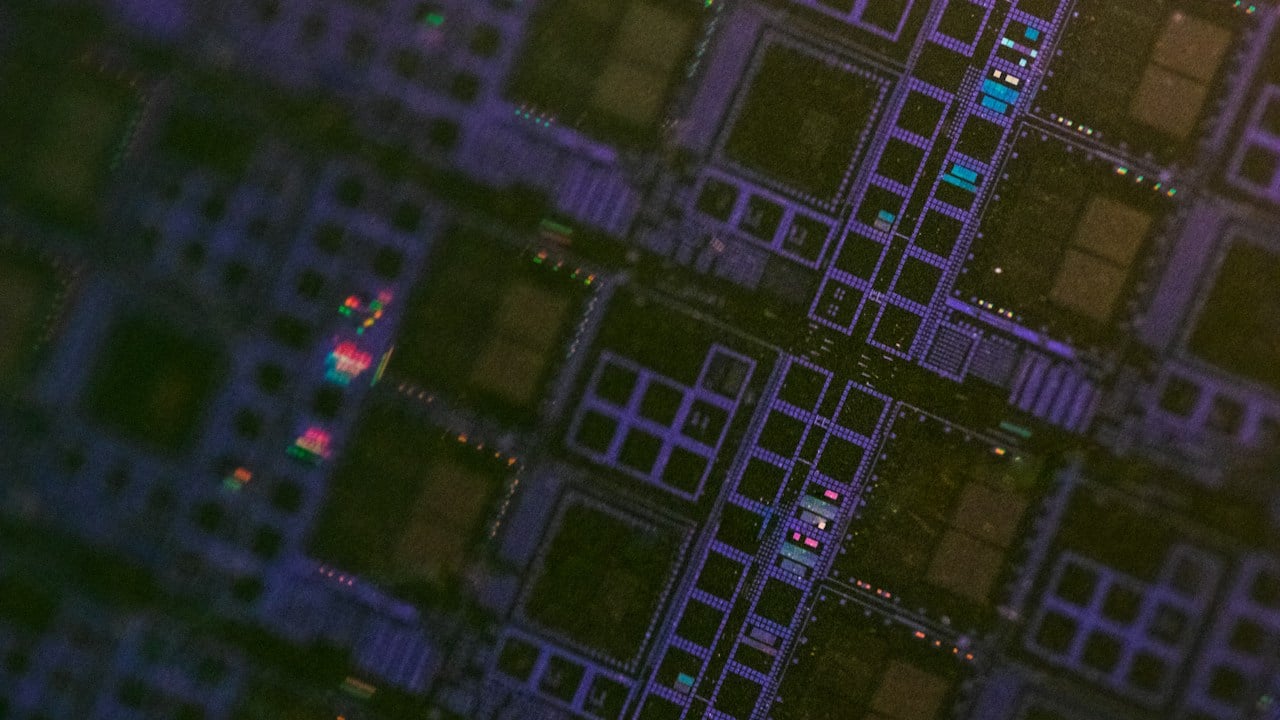 Photo: Jason Leung / Unsplash
Standard running-wave configurations require around 500 microseconds and cool one vibrational direction at a time. The Cornell microchip cooled three distinct motional modes simultaneously across a frequency range of approximately 5 megahertz, as detailed by Interesting Engineering. The measurement behind the team's invention confirms a long-standing theoretical prediction of sub-Doppler cooling within an integrated photonic architecture.
Cryogenic packaging and Dutch fabrication partnerships
To build the hardware, the researchers routed wavelengths ranging from ultraviolet to near-infrared light through the chip substrate. The physical chips were commercially fabricated in the Netherlands through an institutional collaboration with ETH Zurich, while Cornell facilities prepared the devices and developed protective packaging to run at cryogenic temperatures.
Although the experiment tested a single calcium ion rather than a multi-qubit array, the researchers noted that the integrated optical delivery can scale to larger architectures. Removing the need for separate external lasers for each motional mode simplifies the physical hardware needed as trapped-ion processors expand into larger quantum systems, a breakthrough that could soon inspire new patent filings and commercial applications.
Read also on The Patent: Ultracold Lithium Atoms Reveal Competing Quantum Forces · Graphene energy harvester powers wireless sensors from magnetic field leaks