Subsea Telecom Cables Turn Arctic Seafloor into Acoustic Whale Monitors
Researchers detect bowhead whale calls through undersea fiber optic lines using distributed acoustic sensing
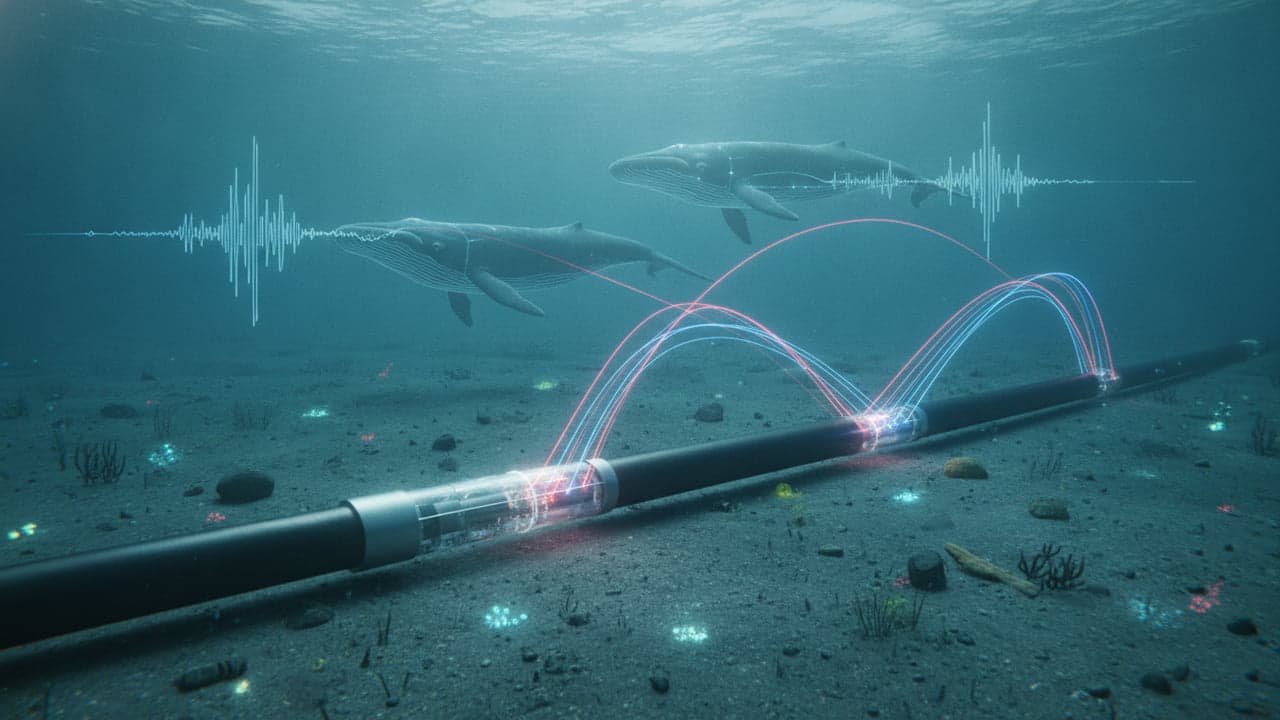
Undersea telecommunications cables can now track bowhead whales across Arctic waters in real time. Bioacoustics researcher Léa Bouffaut has demonstrated that distributed acoustic sensing detects higher-frequency marine mammal calls along seafloor fiber networks, providing a dual-use monitoring tool for conservationists.
Laser pulses turn fiber into thousands of virtual microphones
Subsea cables carry the vast majority of international internet traffic, but their physical structure can also capture ambient ocean acoustics. The invention, based on a technique known as distributed acoustic sensing (DAS), sends laser pulses down standard fiber-optic strands. Sound waves traveling through the water distort the glass fiber by fractions of a wavelength, which alters the backscattered light returning to an interrogator unit on shore, as detailed in research reported by Phys.org.
Measuring these tiny strain changes turns hundreds of kilometers of seafloor infrastructure into continuous arrays of virtual microphones. The technological innovation allows scientists to detect vocalizing marine life from dry land without deploying expensive standalone hydrophones that require ship maintenance and battery replacements.
“Being able to detect bowhead whales on a telecommunication cable is the proof of concept we need to show that DAS can be used to monitor all baleen whales.”
— Léa Bouffaut, bioacoustics researcher at Cornell University
Proof of concept achieved in the freezing waters of Utqiaġvik
Bouffaut, based at the Cornell K. Lisa Yang Center for Conservation Bioacoustics, previously proved that DAS could record blue and fin whales in 2022. Those species emit low-frequency sounds below 100 hertz. Detecting quieter species calling at higher registers, however, presented a much steeper technical barrier.
During the spring of 2026, Bouffaut set up monitoring in Utqiaġvik on Alaska's North Slope. Working alongside the Barrow Whaling Captains Association and the North Slope Borough Department of Wildlife Management, the team connected recording gear to an existing commercial telecommunications link operated by Quintillion. After screening terabytes of raw optical data, Bouffaut logged the first acoustic detections of bowhead whales on commercial undersea cable, capturing calls between 150 and 300 hertz.
Dual use infrastructure for long term ocean sustainability
The findings, synthesized in a study published in the journal Methods in Ecology and Evolution, outline an operational model to repurpose existing industrial networks for marine sustainability. Telecom operators and offshore wind farms already scan underwater lines to safeguard cables against damage, anchors, and natural seabed shifts.
Feeding those continuous optical measurements into bioacoustic pipelines—often processed with artificial intelligence algorithms—gives conservationists an immediate stream of migratory and population data. The approach does not render conventional hydrophones obsolete, but it allows biological monitoring across tens of kilometers of open water where fixed instruments are prohibitively costly to maintain. Bouffaut noted that the methodology provides the foundation to expand dual-use monitoring across global subsea corridors as Arctic sea routes undergo ongoing climatic change.
Read also on The Patent: Bacteria Produce Hormones to Save Corals from Extreme Heat · Fruit and vegetable scraps pack more fiber than flesh, King's study shows