Giovanni Sapere

Norms & Regulation

Federal Circuit overturns 9.1 million dollar fee award in vitamin patent case

The U.S. Court of Appeals for the Federal Circuit reversed a district court order requiring ChromaDex to pay 9.1 million dollars in legal fees to rival Elysium Health. The decision settles an exceptional-case dispute over dietary supplement intellectual property licensed from Dartmouth College. Judges ruled that while ChromaDex lost on patent eligibility, its arguments were neither frivolous nor foreclosed by Supreme Court precedent.

Giovanni Sapere

Space

NASA Map Identifies 13 Possible Martian Origins for Teghaza 001 Meteorite

Scientists studying Mars have pinpointed 13 candidate source locations for Teghaza 001, one of the oldest Martian meteorites discovered on Earth. Using spectroscopic and topographical observations from orbital missions in space, researchers traced the unique chemical composition of the rock back to specific highland regions in the Martian southern hemisphere.

Giovanni Sapere

Chemistry

Soil Bacterium from Iran Yields Two New Chemical Compounds

Biochemists in Germany have isolated two previously unknown natural molecules, lavasamycin A and B, from a bacterial strain collected in Iran. The study shows that lavasamycin A stops the growth of Bacillus subtilis, pointing to chemical structures that could aid the invention of new antimicrobial agents.

Giovanni Sapere

Environment

Ancient Tibetan Ice Cores Extend Mountain Climate Record to 128,000 Years

A scientific innovation in geochemical dating has revealed that glacial ice from northwestern Tibet is more than 128,000 years old. Researchers at Ohio State University demonstrated that high-altitude glaciers endured the transition out of the last ice age, extending the known climate record for the region by more than 100,000 years.

Giovanni Sapere

Chemistry

Salt Additives Solve Perovskite Crystal Defects in Solar Cells

A chemical method using salt additives resolves atomic structural flaws in perovskite crystals, offering a practical path forward for renewable energy devices. Researchers at the U.S. Department of Energy's Argonne National Laboratory demonstrated that temporary liquefaction prevents electric charges from becoming trapped in crystal boundaries. This innovation enables solar cells to retain 85.8 percent of their efficiency after 1,400 hours of continuous operation at 85 degrees Celsius.

Giovanni Sapere

Space

Hubble Telescope Upends Theory on How the Early Universe Cleared Its Cosmic Fog

Astronomers using NASA's Hubble Space Telescope have uncovered evidence that overturns an established model of cosmic history. Observations published in Nature Astronomy reveal that powerful stellar explosions did not help ultraviolet radiation escape ancient galaxies, but instead trapped it inside dense clouds of gas.

Giovanni Sapere

Medicine

Switching Off TET2 Turns Radiation-Triggered Immune Cells Against Tumours

Radiation therapy kills cancer cells by damaging their DNA, yet it can also trigger the bone marrow to produce suppressor cells that protect surviving tumours. A research team at the University of Chicago has discovered that inhibiting an enzyme called TET2 reverses this effect, providing an epigenetic innovation that helps radiation and immunotherapy shrink lesions and curb metastasis. Their study, published in Cancer Cell, demonstrates the mechanism in clinical samples and animal models.

Giovanni Sapere

Archeology

Spear Wound in Shanidar Cave Points to Oldest Wooden Weapon Attack

A 75,000-year-old Neanderthal skeleton discovered in Iraqi Kurdistan carries what may be the oldest fossil evidence of fatal violence inflicted by a wooden spear. Excavated beneath almost eight metres of rock and sediment, the left shoulder blade of the individual known as Shanidar A preserves a clean circular puncture directed through the chest. The finding, reported in Scientific Reports, suggests that early hominins used pointed wooden projectiles not only for hunting large game but also in deadly interpersonal conflict.

Giovanni Sapere

Archeology

Egyptian Ape Fossil Shifts the Geographic Roots of Modern Primate Evolution

Researchers from Egypt and the United States have identified a new species of ancient ape from lower jaw fossils recovered at Wadi Moghra in northern Egypt. The specimens, dated to between 17 and 18 million years ago, represent the first definitive fossil ape discovered in North Africa. Published on March 26, 2026, in Science, the discovery indicates that the ancestors of modern apes and humans may have emerged along North Africa and the Middle East instead of East Africa.

Giovanni Sapere

Science

Colloidal Anti-Spin Ice Created with Rotating Magnetic Fields

Physicists have constructed an artificial anti-spin ice that reverses the basic rules governing frustrated magnetic matter. As reported by [Phys.org](https://phys.org/news/2026-10-ice-scientists-particles-anti.html), the physics innovation relies on microscopic beads exposed to a spinning magnetic field that forces them to attract rather than repel each other.

Giovanni Sapere

Space

A forgotten heavy neutrino may solve why matter survived the Big Bang

Physicists from the University of Southampton and the Indian Institute of Technology Kanpur have found that a neglected particle may explain why matter exists today instead of empty space. Their analysis shows that a decoupled heavy neutrino briefly dominated the cosmos after the Big Bang, tipping the balance against antimatter.

Giovanni Sapere

AI

OpenAI and Anthropic claim AI solved a 27-year-old computer science problem

Teams at OpenAI and Anthropic claim that artificial intelligence has cracked a 27-year-old pillar of computer science. The achievement forms one of three major claims from OpenAI, opening fresh debates on intellectual property and the distribution of machine-generated scientific findings.

Giovanni Sapere

Physics

Two electrons unite to push laser X-rays beyond standard physics limits

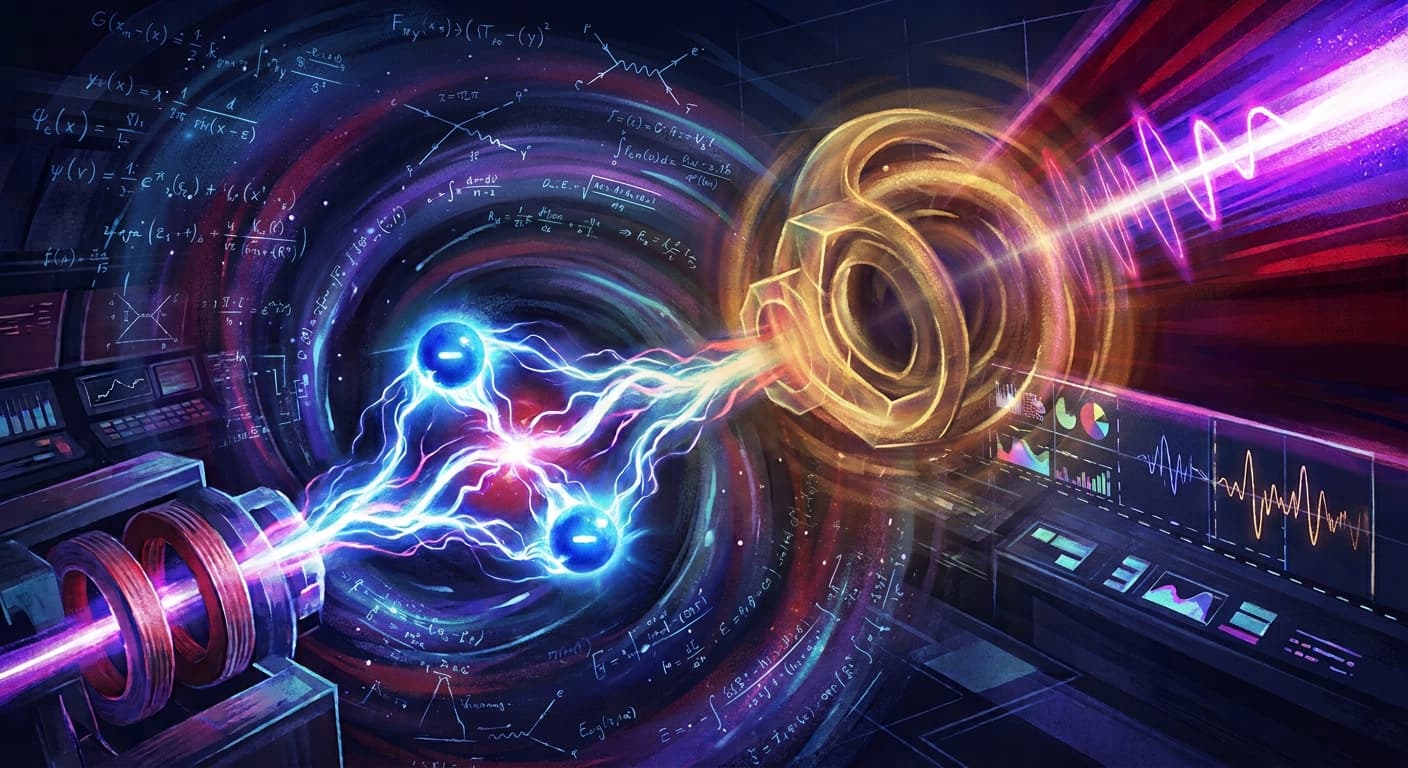
Physicists at TU Wien and the University of California San Diego have found a way to generate X-rays with higher energies than standard theoretical limits permit. By synchronizing two electrons in helium atoms with ultraviolet laser pulses, the team triggered a combined energy release that creates unusually energetic photons. The scientific innovation challenges long-standing assumptions about how laser-driven radiation is generated at the atomic level.

Giovanni Sapere

Construction

ETH Zurich turns sand into solid biocement using bacteria

Engineers at ETH Zurich have developed an architectural innovation that binds ordinary loose sand into rigid building components using living bacteria. Led by Karen Antorveza Paez, the team created two fabrication methods that avoid the high heat and heavy carbon emissions of conventional cement production, as reported by [New Atlas](https://newatlas.com/materials/biocement-solid-sand/).

Giovanni Sapere

Medicine

Ten Blood Markers Predict Aging Health and Cardiometabolic Disease Risk

Researchers at Leiden University Medical Center and the Max Planck Institute for Biology of Aging have developed a personalized metabolic score that evaluates disease risk and healthy aging. Presented at the FAPESP Week Netherlands conference, the innovation analyzes ten routine blood substances to generate a single profile of metabolic health. A one-point rise on the inverted scale corresponds to an average 14-year delay in the onset of cardiometabolic conditions.

Giovanni Sapere

AI

Beijing researchers design bone scaffolds in 12 seconds with AI

Engineers and medical researchers at Beijing Rehabilitation Hospital, affiliated with Capital Medical University, have introduced ScaffoldForge, a generative artificial intelligence system for bone repair. The tool designs customized bone scaffolds in roughly 12 seconds, shifting a calculation process that previously required hours of computing time.

Giovanni Sapere

Inventions

Intestine-inspired biobattery generates eight times more power

Engineers at Binghamton University have developed a bacteria-powered biobattery that produces over eight times more electricity per unit volume than conventional flat designs. The biological invention copies the shape, material, and mechanics of the villi that line the human small intestine to keep electricity-generating microbes alive and active.

Giovanni Sapere

Makers

Ben Krasnow 3D prints a clear Einstein-Szilard refrigerator powered by flame

Maker Ben Krasnow has constructed a transparent, 3D-printed absorption refrigerator based on the historic Einstein-Szilard design, proving that an open flame can drive a cooling cycle without mechanical compressors. The project brings a classic thermodynamic invention to life, allowing observers to see the phase changes inside the pressurized fluid loop.

Giovanni Sapere