Marshall Islands Atolls Form Pristine 48,000 Square Kilometre Sanctuary
Surveys across Bikar and Bokak document hundreds of marine species and establish the nation's first national marine sanctuary.
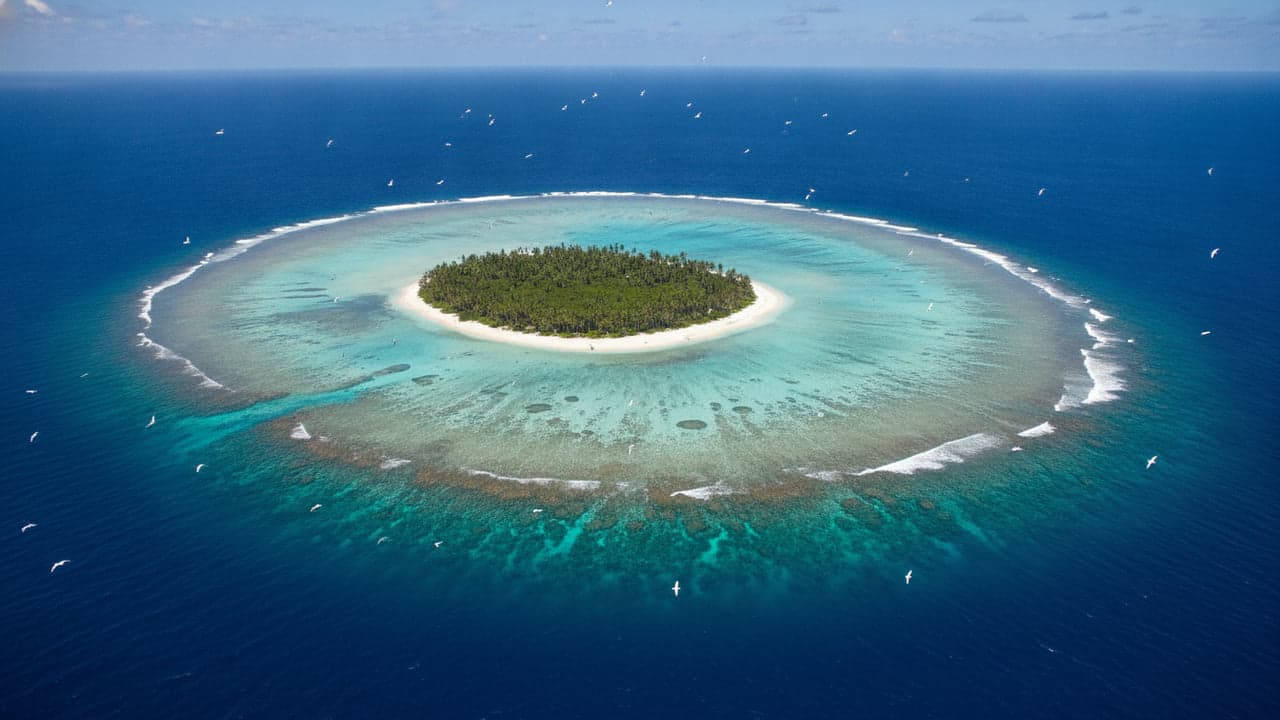
Two remote Pacific coral atolls remain among the most intact marine ecosystems on the planet, according to a study published in Frontiers in Marine Science. Researchers led by the University of Hawai'i and National Geographic Pristine Seas evaluated Bikar and Bokak in the Marshall Islands, discovering potential new species and recording massive predator populations. The scientific baseline helped secure official protection for 48,000 square kilometres of ocean as a national marine sanctuary.
A systematic survey from sky to seabed
In 2023, a joint scientific expedition set out to create an ecological baseline for the northernmost atolls of the Marshall Islands. Bikar and Bokak lie isolated in the open Pacific, situated 116 kilometres and 385 kilometres respectively from the closest inhabited atoll, as reported by Phys.org.
To document these environments before major climatic disruptions take hold, researchers used a multi-layered method that combined scuba surveys, baited underwater video stations, deep-sea cameras and a submarine. The research represents a methodological innovation in environmental assessment by sampling from the terrestrial canopy down to the benthic floor. The team recorded 15 seabird colonies that were confirmed or likely breeding, while observing undisturbed stands of mature native vegetation on land.
“They are among the best ecological reference systems we have to better understand what we have lost elsewhere and to provide fundamental insights needed for effective conservation and restoration efforts”
— Dr. Alan Friedlander, Chief Scientist at Pristine Seas and Marine Ecologist at the University of Hawai'i
Marine life differences across two isolated reefs
The marine life recorded across the two atolls highlights an environment almost free from human extraction. The expedition identified 266 groups of reef fish, 138 groups of fish at greater depths and 79 groups of deep-sea fishes. Large predators such as gray reef sharks, blacktip reef sharks, jacks and wahoo populated the open waters across both locations.
Despite their proximity, the two atolls exhibit notable ecological differences. Bokak supported a higher biomass of reef fish and extensive coral-dominated communities. In contrast, Bikar contained a greater variety of algae taxa and served as a major breeding ground for marine reptiles, with researchers counting 132 green sea turtle nest pits. Across both atolls, 14 observed groups had never been previously recorded in the Marshall Islands, and two specimens may represent species entirely new to science.
Legal protection and customary management
The findings provided the scientific foundation for the Marshall Islands to formally designate 48,000 square kilometres around Bikar and Bokak as the country's first national marine sanctuary two years after the survey. The legal designation operates under the national Reimaanlok framework, a term meaning looking toward the future, which blends modern conservation policy with community-led governance.
The atolls were safeguarded for decades by the traditional leaders and residents of Utirik Atoll. Unlike industrial marine zones subject to commercial claims or private intellectual property over genetic resources, the sanctuary establishes public conservation status over the waters. The protection aims to maintain biodiversity and local ecological sustainability across generations.
Reference baselines for ocean monitoring
Because Bikar and Bokak have experienced minimal direct human disruption, they serve as rare ecological controls for marine biologists worldwide. Researchers can compare degraded coastal systems against these undisturbed baselines to calculate how much biomass, predator density and coral cover has disappeared elsewhere.
The authors of the study note that the 2023 survey represents a single snapshot in time. Future monitoring will need to investigate nutrient transfers, water exchange and ecological connectivity between habitats to determine how remote atolls respond to changing ocean temperatures.
Read also on The Patent: UNSW researchers track persistent chemicals in farmland sewage fertilizer · Bacteria Produce Hormones to Save Corals from Extreme Heat